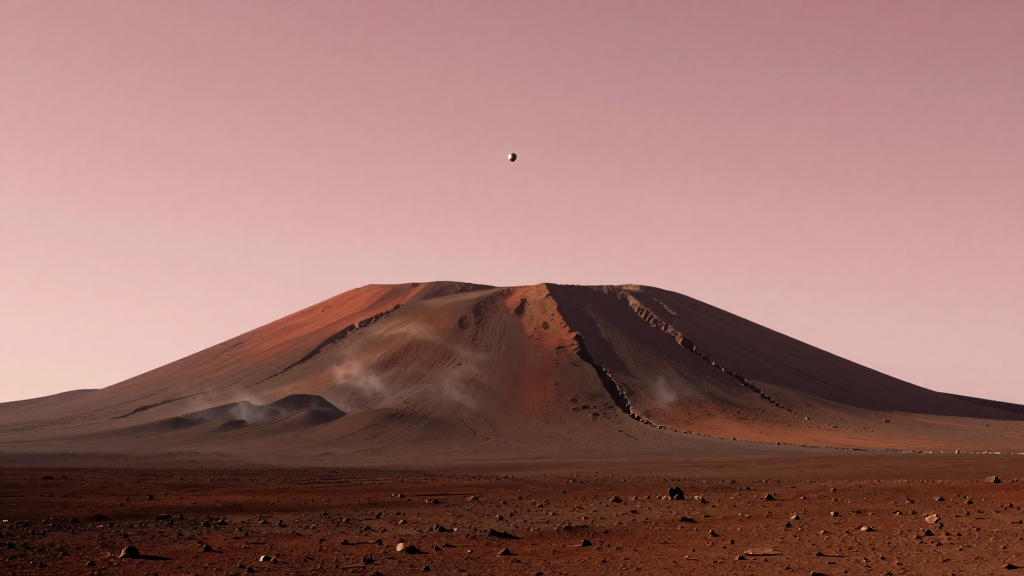
For twenty years, the paperwork on Mars said dead. Not “apparently dead,” not “presumed dead” — dead, the way a textbook says it, with the confidence of a document that has never been to the planet and filed the certificate anyway. This week, a European orbiter found hydrogen chloride leaking out of fresh cracks above Alba Mons, a volcano the size of Hawaii laying dozy in the northern hemisphere, and the paperwork has been recalled.
The correct reading, per the mission scientists, is not that Mars is erupting. It is that Mars is venting — exhaling magmatic gas through fissures along the flanks of a volcano whose plumbing, it now appears, was never disconnected. The planet is not dead. The planet is napping, badly, on its stomach, with the heat still on.
“We have been landing on a sleeping giant with a stethoscope and declaring the patient deceased because it wasn’t talking,” said Dr. Ilse Marchetti, a planetary geochemist who has spent the week doing interviews she described, with total sincerity, as “the apology tour.”
The correction matters more than the discovery. A dead Mars was a closed case — a planet that had its moment, cooled, and filed out, which let scientists date its rocks, doubt its oceans, and plan human visits with the smugness of landscapers evaluating a vacant lot. A sleeping Mars is an open tab. Its interior still moves, which means its history still has authorship, which means every conclusion drawn from “dead” for two decades now carries a footnote, and in science, footnotes are where the receipts collect interest.
Dr. Marchetti put the actual discovery in the smallest possible terms, which is how scientists discuss things they know will be shouted about. Hydrogen chloride, she explained, is not a gas you find by accident in concentration. On Earth it rides with magma. It does not linger, it does not recycle gently, and finding it pooled above fresh ground cracks is, in her words, “like smelling dinner in a house everyone agreed was abandoned — it means someone is home, and the oven is on.”
The Alba Mons system helps explain why nobody noticed. It is a low, sprawling volcano, more pancake than peak, the largest of its kind on the planet — a feature so big that orbital cameras kept photographing it as terrain rather than plumbing. The fissures are recent by planetary standards, crisp-edged, and sitting directly above what the team’s modeling suggests is a dormant magma chamber still faintly cooking. Sleeping, in other words, with the pilot light on.
There is no indication of an eruption, and the researchers said so four separate times, in the exact flat voice of people who know what headlines do. What there is instead is a planet that has been keeping a secret from an entire profession for twenty years, and the profession’s honest reaction, as Dr. Marchetti described it, has not been excitement. It has been embarrassment — the particular embarrassment of a doctor who pronounced a patient gone and has just been handed the patient’s coffee.
Mars, for its part, has no statement. It has venting, which is what it has been doing the whole time, and which is now, finally, on the record.