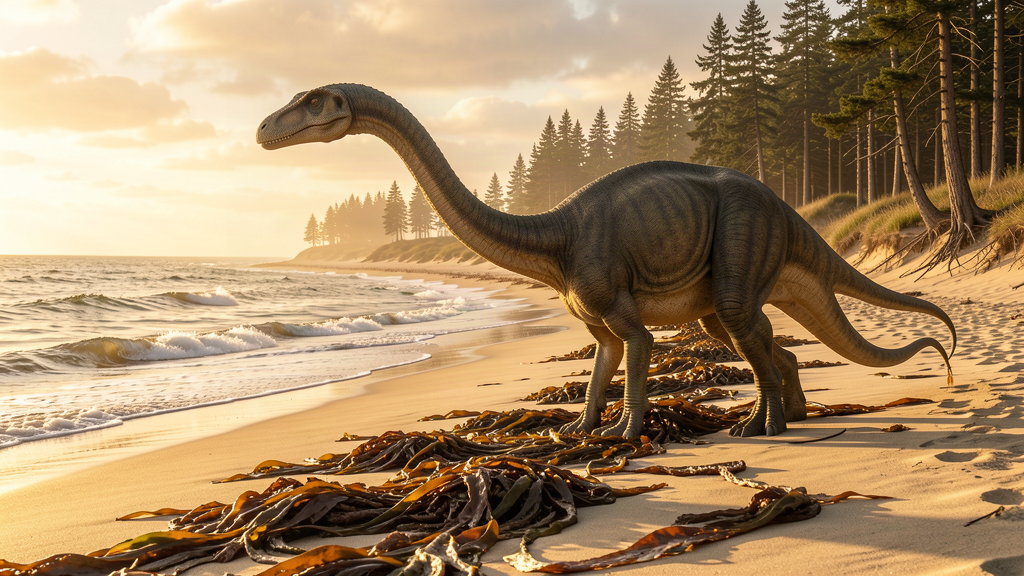
RALEIGH, N.C. — Science has answered one of the great unanswered questions of the Mesozoic Era — what, exactly, did a dinosaur do at the beach? — and the answer is the same thing every American does at the beach: eat something off the ground.
Researchers at NC State examined carbon isotopes in fossilized teeth and bones from dinosaurs that lived along ancient North American coastlines more than 100 million years ago and found a chemical signature consistent with seafood and seaweed in the diet. The large plant-eaters, the study suggests, may have browsed marine plants directly. The meat-eaters, never far behind a good idea, acquired the same signature by eating the plant-eaters, which is how every buffet works.
The finding has been reported with the restraint proper to science, which means it has not yet been reported with the enthusiasm proper to America. A herbivorous dinosaur, walking a tide line, eating seaweed, is not a new animal. It is a beachgoer. The only difference between a hadrosaur and a coastal tourist is that the hadrosaur had no car and no cooler, and yet it fed its family with the same calm efficiency.
The isotope method is beautifully simple. Carbon-13 ratios in bone and tooth enamel record where an animal’s food came from: land plants sit at one value, marine food at another. The coastal dinosaurs’ teeth sat between the two, which scientists call a “mixed signal” and which everyone else calls a varied diet. The study, published in Frontiers in Ecology and Evolution, compared dozens of specimens from ancient shorelines against their inland cousins, and the shoreline animals lit up like holiday lights on the marine axis.
THE CRETACEOUS COASTAL DIET: WHAT WE NOW KNOW
- The evidence: Carbon-13 signatures in fossil teeth and bones, a record that cannot lie because it is rock.
- The menu: Seaweed, washed-up marine plants, and whatever else the tide delivered, which in the Cretaceous included opportunities.
- The predators: Inherited the seafood signature secondhand, by eating the beachgoers, a practice nutritionists do not recommend and evolution does not police.
- The location: Ancient North American coastlines, meaning this happened in America, a fact the study mentions once and America should mention daily.
- Calories per seaweed: Unknown. The dinosaurs' silence on the matter is being read as satisfaction.
Paleontologists stress the result is a “may have,” the polite hedge that lets a scientist say something enormous while appearing to say something small. The dinosaurs may have eaten seaweed. They may have been the first vertebrates to meal-prep from a tide pool. They may, in the deep chemical memory of their own teeth, have liked it.
At press time, a marine biology graduate student attempted to replicate the diet for one week on seaweed alone and reported feeling “humbling,” a word the researchers said they had never before associated with lunch.