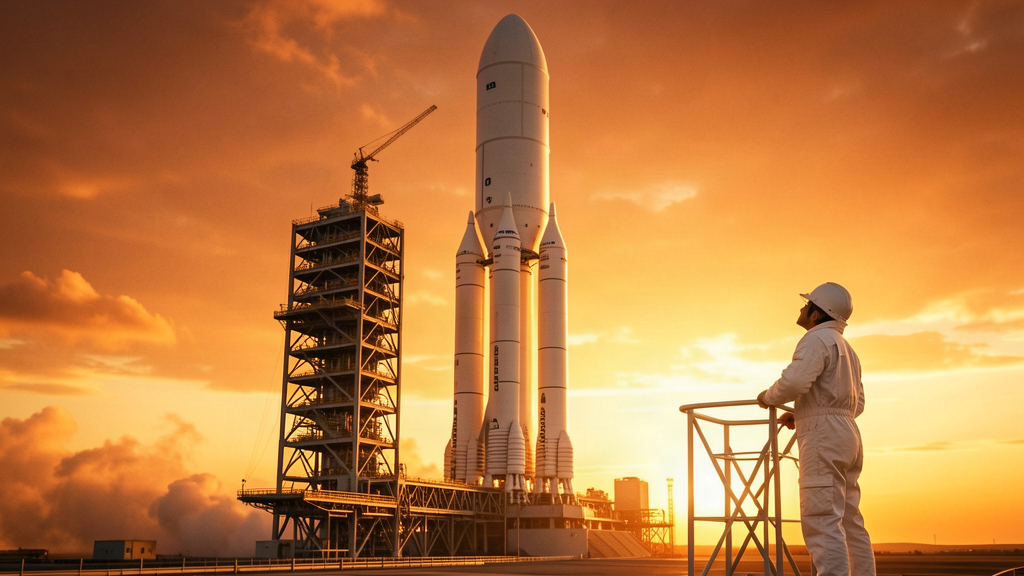
HOUSTON — NASA’s Roman Space Telescope has been cleared for final launch preparations ahead of a targeted August 30 liftoff aboard SpaceX’s Falcon Heavy, which is a phrase that, in the aerospace industry, means the paperwork is done and the rocket has been moved to a spot where it cannot legally be moved again.
The Nancy Grace Roman Space Telescope, named for the astronomer who helped lay the groundwork for the study of dark energy, will carry a mirror the size of Hubble’s but see a patch of sky roughly 100 times wider in a single shot, according to NASA’s own mission page.
That 100-to-1 number is the part that makes space scientists lose their composure in interviews. Hubble, for reference, took 31 years to complete its deep field surveys. Roman will do in weeks what Hubble would do in centuries, which is the kind of math that gives astronomers the exact same feeling as a tax refund, except in a direction.
The observatory will survey on the order of a billion galaxies, measuring how they are distributed and subtly distorted in order to trace how the expansion of the universe has changed over time — a job description that, if you read it at a party, sounds exactly like what you’d expect from a person who has never once been asked to make small talk about their weekend.
It is also expected to detect around 100,000 new worlds, more than all previous planet-hunting observatories have found combined, as Space Daily noted in its countdown coverage.
The quote is from a planetary scientist who asked to be described as “a very normal person with a very normal career,” a description that is, in his field, a claim of enormous distinction.
The launch is scheduled for 7:26 a.m. Eastern from Kennedy Space Center, which is a time that, in Florida, means the sun will be in exactly the right place to make the Falcon Heavy look like it was placed there by someone with a point, which, in this case, it was.
THE ROMAN MISSION, BY THE NUMBERS
- Launch window: August 30, 7:26 a.m. EDT
- Ride share: SpaceX Falcon Heavy, Kennedy Space Center
- Mirror: The size of Hubble's
- Field of view: About 100 times Hubble's, in a single shot
- New worlds expected: Roughly 100,000 — more than all previous missions combined
- Galaxies to be surveyed: About a billion
- Main job: Dark energy, exoplanets, and "astrophysics," which the agency lists as its own bullet point
NASA, for its part, describes the telescope as one that “will settle essential questions in the areas of dark energy, exoplanets, and astrophysics,” a list that reads, to the uninitiated, like a course catalog for a graduate program nobody applies to on purpose.
At press time, the countdown page is live, the Falcon Heavy is on the pad, and a NASA official described the preparations as “right on track,” a phrase that, in the space program, has a success rate of roughly the same as a telescope’s field of view: about 100 times better than it should be.