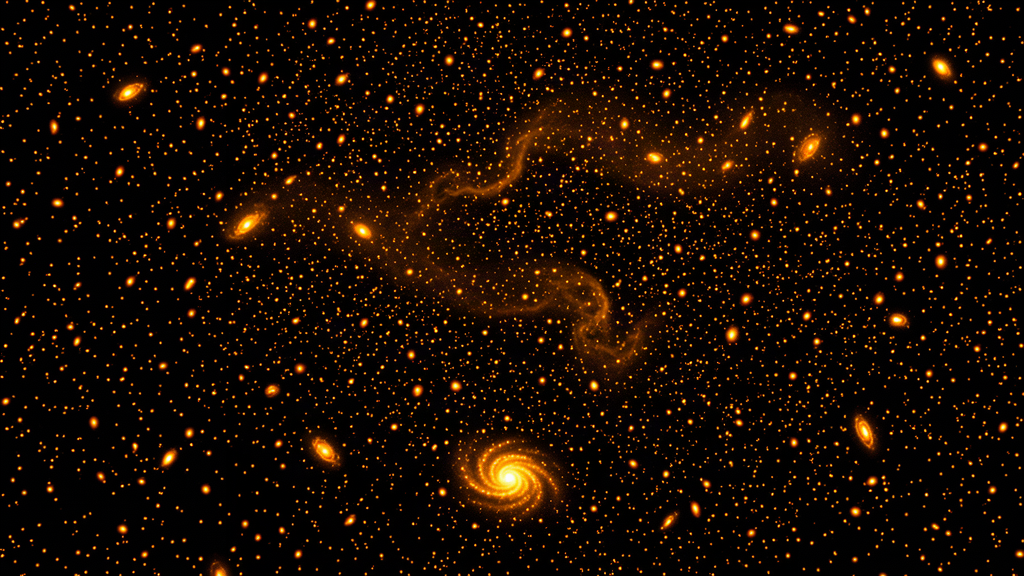
TUCSON, ARIZONA — Astronomers have known for decades that the very early universe was a clean place: hydrogen, helium, and not much else, the cosmic equivalent of a freshly made bed. This week, NASA’s James Webb Space Telescope reported that the bed was not made. Galaxies just 500 million years after the Big Bang were already spraying carbon, oxygen, and silicon into the space around them, which means the universe got messy, fast, and apparently before anyone was there to tell it to stop.
The finding comes from observations of three galaxies in the first half-billion years of everything. Inside them, stars had already lived, cooked heavy elements in their cores, and then — this is the part that broke the models — died loudly enough to scatter those elements into the gas between galaxies. The textbook said the young universe was pristine. The textbook was written by people who had never seen a college dormitory four hours after move-in day.
“We expected the early universe to be chemically simple,” said Dr. Helen Márquez, an astronomer on the team, in the time-honored scientific tradition of announcing that the expectation was the problem. What the data show instead is a cosmos that began recycling its trash almost immediately, forging the raw ingredients of planets, oceans, and eventually grocery stores while the universe was still, by any standard, an infant.
THE EARLY UNIVERSE: CLEANLINESS INSPECTION
- Expected: Hydrogen and helium only. Tidy.
- Found: Carbon, oxygen, and silicon drifting between galaxies at redshift dawn.
- Age of the universe at the time: 500 million years — roughly 3.5 percent of its current age, or a newborn.
- Source of the mess: Stars that formed, fused, and exploded with unprofessional speed.
- Verdict: The Big Bang's promise of a clean slate lasted approximately one cosmic afternoon.
The result matters because heavy elements are the entire inventory of real life. Every atom of calcium in a human skeleton was manufactured inside a star that behaved this badly. The Webb did not just find pollution in the early universe; it found the supply chain. The complaint that the early universe was messier than expected is, from the perspective of everything made of carbon, the best news in the history of complaints.
At press time, the team announced it had pointed Webb at an even earlier galaxy and found what appeared to be a cosmic dust bunny the size of a small cluster. They are watching it closely. It is growing.