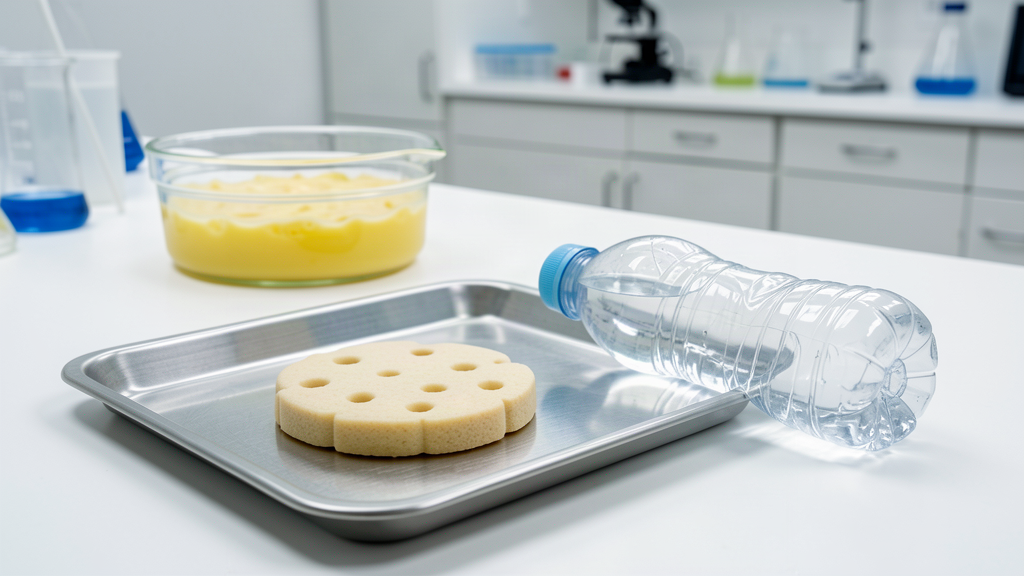
CHICAGO — A cookie, presented this week at the American Chemical Society’s fall meeting, was made, in the specific, out of a plastic bottle, and the scientists who made it are, per the abstract, “proud.” The cookie is called a µBite, it is protein-rich, it is 3D-printed, and it is, per the researchers who engineered the yeast that turns polyethylene terephthalate into a snack, “a solution.”
The work, presented in Chicago, was developed partly for NASA’s Deep Space Food Challenge, which is the competition that asks, with a seriousness the researchers are now matching, how you feed a crew on a mission where a supply truck is, in the specific, not a thing. The answer, it turns out, is a yeast. The yeast, which the team genetically engineered, eats PET plastic and agricultural waste and, over the course of a process involving heat and pressure, produces the ingredients for a cookie, and the cookie, per the team, is “vanilla.”
The process, which the team describes as a “system,” starts with the PET that is, in the specific, your water and soda bottle, and uses water and oxygen under extreme heat and pressure to break the plastic and the biomass into bite-sized pieces that a microbe can then, in the words of one of the researchers, “work with.” The output is a cookie with protein, fats, vitamins, and, per the flavor profile, vanilla, which is, for a cookie made out of a bottle, the detail the room kept coming back to.
The researchers say the technology could also be useful on Earth, in disaster zones and other places where a conventional food supply is, in the specific, “difficult to maintain,” which is the phrase the team used to describe a situation that the team, per the abstract, is, in the specific, “addressing.” The same yeast that can feed an astronaut, they note, can also, in the estimation of the people who engineered it, feed a person on the ground, which is, for a plastic bottle, a wide career.
THE µBITE: SPECIFICATIONS, AS PRESENTED
- Input: PET plastic (the bottle) plus agricultural waste, a pairing the team describes as "abundant"
- Process: Water and oxygen under extreme heat and pressure, which the team calls "the system"
- The microbe: Genetically engineered yeast, which is, per the team, "the interesting part"
- Output: A protein-rich, 3D-printed cookie, in vanilla, which the team, in the specific, "stands behind"
- Intended use: Deep-space missions, disaster zones, and "anywhere a supply run is difficult," a list the team is "extending"
A food scientist who was not part of the team but was in the room when the cookie was presented described the moment as “the moment the bottle and the cookie became the same object.” “For a long time the bottle was the problem and the cookie was the treat,” he said. “Now the bottle is the treat, and the treat, per the flavor, is vanilla. That is, in the specific, the future they are describing, and the future, as of this week, has a taste.”
At press time, the team had not yet named a restaurant, a snack bar, or a launch window, but had, per a spokesperson, “a cookie to hold up,” and the bottle, which was, until this week, a thing you recycled, was, as of the presentation, a thing you, in the specific, could also, in the words of the room, “have.”