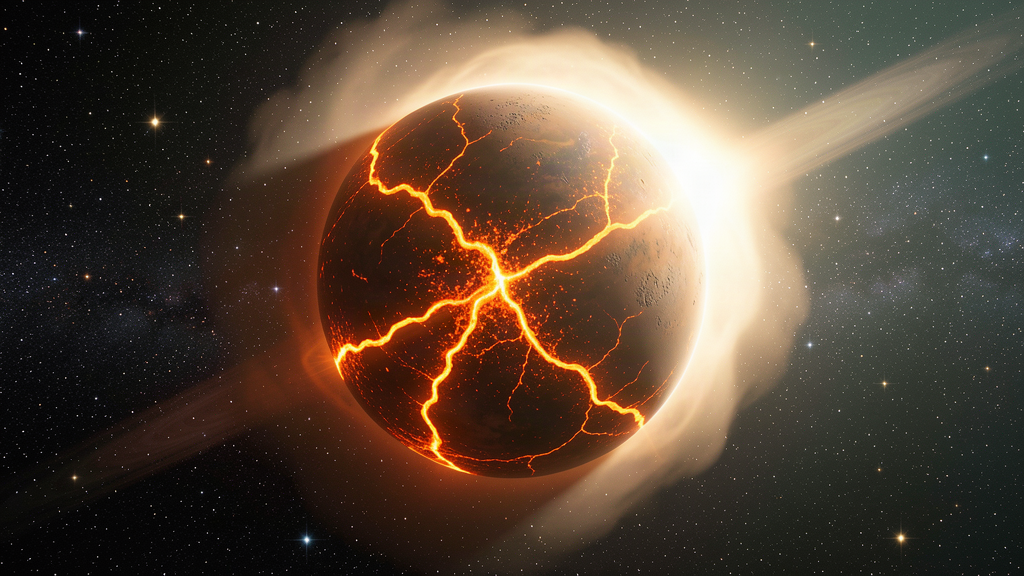
BALTIMORE — Astronomers using the James Webb Space Telescope have confirmed that HD 3167 b, a lava world 154 light-years away that was expected to be a bare rock with nothing on it, has something on it after all: an atmosphere, thin, stubborn, and apparently unbothered by the fact that everything about its situation is terrible.
The planet, a rocky super-Earth in the constellation Pisces, completes one orbit of its star every twenty-four hours. Twenty-four hours. Every day on HD 3167 b is a full year, which means the planet experiences sunrise, noon, sunset, and midnight on the same schedule you experience a weekend, and it has retained a blanket of gas through all of it.
The evidence came from a temperature reading. The planet’s dayside — the side that permanently faces its star, the side that should be the hottest possible thing a rock can be — measured cooler than physics said it had to be. Something was carrying the heat around. That something, the researchers concluded, is an atmosphere, likely rich in silicates, which is a polite way of saying the planet is wearing a coat made of vaporized rock.
The finding matters, scientists say, because it suggests that even punishing worlds can hold onto gas, which in turn suggests that the early Earth — also hot, also under siege, also told it had no business keeping an atmosphere — had a better chance of keeping ours than anyone thought. The universe gave the planet a furnace and the planet installed curtains.
HD 3167 b: THE CONDITIONS REPORT
- Distance: 154 light-years, in Pisces, the fish, which is not where you would look for lava
- Year length: 24 hours, the fastest commute in the solar neighborhood
- Dayside: molten, permanent, and measurably cooler than its résumé implies
- Atmosphere: probably silicate vapor, meaning it rains rock, probably sideways
Not everyone is persuaded. Rival teams are already arguing over whether the cooling comes from an atmosphere or from some other mechanism, which is what scientists do when they are excited, and they are clearly excited, because they have written a paper about a planet that refuses to be empty.
At press time, the team had requested additional telescope time to study the planet’s terminator — the line between its permanent day and permanent night — where, they noted with visible feeling, the weather would be “the most interesting weather in the sky.”