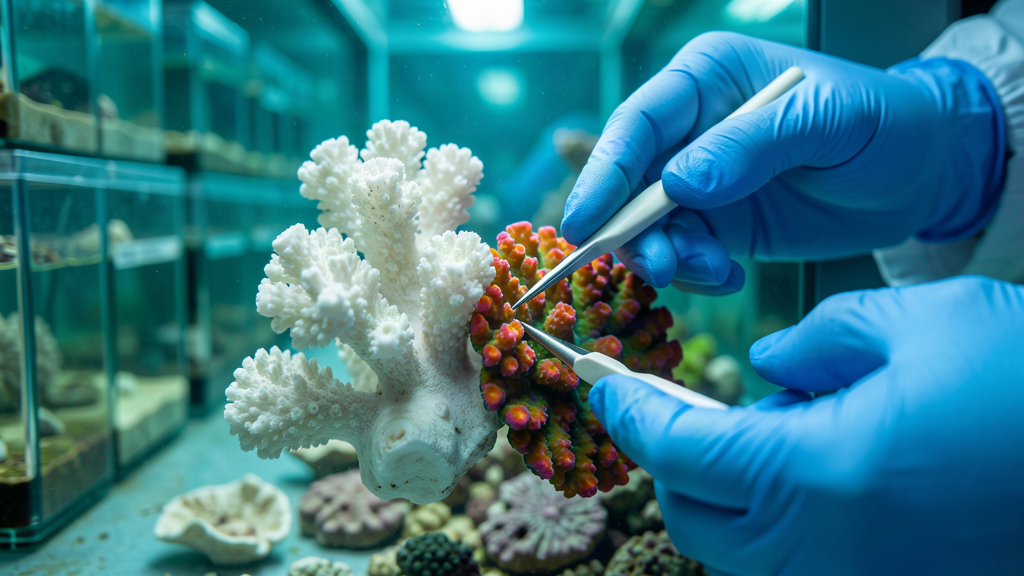
In a tank at Stanford, a dying coral the color of old bone is sitting next to a healthy coral of the exact same animal — its own clone, cut from the same original — and they are touching. The study, published in Science Advances, reports that the dying one got better. In seven weeks it was not the color of bone anymore. It was coral again.
The person who actually arranged the date is the part of this story nobody has printed yet.
Nadia Okonkwo is a third-year doctoral researcher whose published contribution to marine science so far is a 2024 methods note on bracket placement, and who last spring performed the most important act of her life with a pair of ceramic forceps. Bleached fragments of Acropora in the lab were dying on schedule — heat-stressed, stripped of their symbiotic algae, going ghost-white one cell at a time, the standard tragedy of the warming ocean. The lab’s habit was to keep sick fragments apart from healthy ones, in case of disease. Okonkwo, on a Friday afternoon that she has described to colleagues as “mostly autopilot,” set a bleached fragment in direct tissue contact with a healthy fragment of its own clone, because the rack had an empty slot.
Five days later, the bleached fragment had color near the contact line. Nature summarized what the team watched happen over the following weeks: pigment returning from the seam outward, like ink through wet paper. “All bleached corals in direct contact with healthy coral achieved complete recovery within eight weeks,” the paper states, and one fragment was fully healed in four.
The mechanism, as best anyone can say it in a newspaper: the corals fuse tissue, and through the fused seam they share their algae — the tiny partners that give coral both its color and its lunch. The healthy clone is, functionally, feeding its own other self. The scientists used words like “remarkable” and “unprecedented.” Okonkwo, asked what she thought when the color started moving, said: “I thought the rack was dirty and I was going to get in trouble. Then I looked again.”
Every result came with an asterisk that the press office kept and the headline makers usually drop: this happened in tanks, to fragments, between identical individuals. Two strangers will not do it. The reef, which is an entire neighborhood of near-strangers, is not a tank.
None of which has stopped the phrase “holding hands” from appearing, once, in this article, and possibly in your heart.
For the record, the fastest full recovery the study documented took: four.