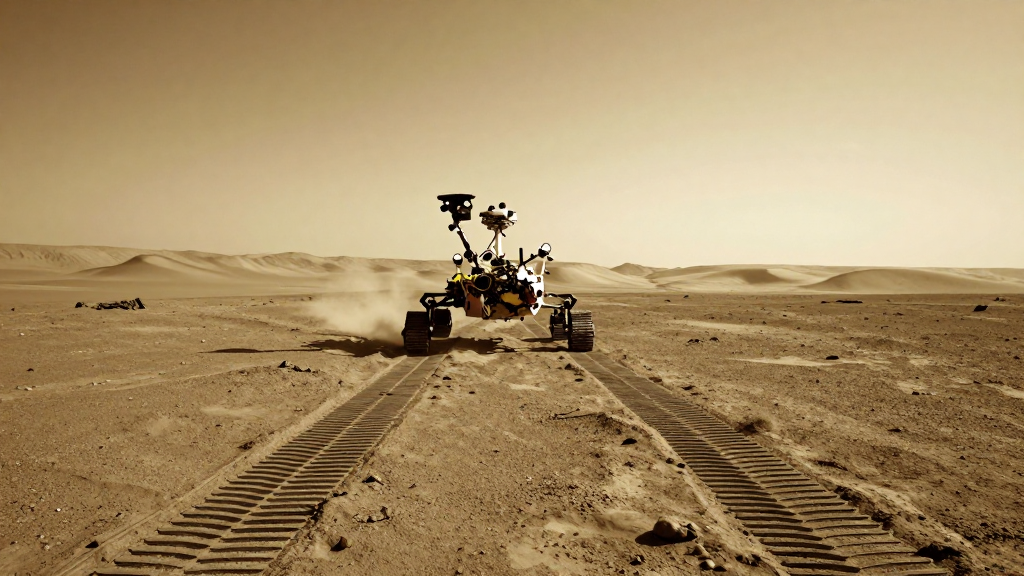
At 6:12 a.m. Eastern on Oct. 11, a woman at a desk in Pasadena watched a number change on a screen and became, professionally, the witness to the closest finish in the history of distance.
Ines Okafor is the assistant to the deputy drive-team lead at NASA’s Jet Propulsion Laboratory, a title built so that someone, someday, would have to say it in a press release. The number on her screen was Perseverance’s odometer: 28.10 miles. The previous record for any vehicle driven on another world was 28.06, set by the Opportunity rover, which held it from the surface of Mars itself, motionless, since 2018.
Four hundredths of a mile. Two hundred eleven feet. The most dominant margin of victory in off-world history, about as far as three and a half bowling lanes laid end to end, and the largest lead Perseverance has ever had over anything, because the previous record-holder cannot drive.
“The engineering did not need four hundredths,” Okafor said. “The engineers need me to tell you we beat it anyway. So: we beat it anyway.”
The odometer is an easy thing to misunderstand. On Earth it measures the guilt of a leased car. On Mars, at a light delay of anything from four to twenty-four minutes — “you cannot drive a car here, you can only propose a drive,” as Okafor puts it — it measures the sum of ten thousand small decisions made by a machine about rocks. Perseverance has been driving, in pieces, since it landed in February 2021. It has driven farther than any vehicle on any world while its drivers sat in California drinking coffee that was older, in transit time, than some of the drive commands.
NASA says the record is “far from done”, which is the correct way to describe an odometer: the number only stops when you stop, and the rover has no idea how to stop, because its job is the opposite. It is currently accumulating distance at the rate of a very careful parking lot, one sample tube at a time, leaving a road behind it that no one will ever drive.
Opportunity, the old record-holder, was overtaken at a dead standstill, buried in a dust storm eight years ago, on the other side of a planet it had driven nearly the same distance across. Perseverance passed its odometer reading without passing its body. This is, at this point, the closest thing Mars has produced to a memorial service: two machines, one number, and a woman in Pasadena who double-checked the digits nine times, for the record.
The margin of victory, official: four hundredths of a mile. The margin of victory in the Apollo 11 landing: about twenty seconds of fuel. Mars, it turns out, runs its races the way all races really are run — by the smallest possible amount, by whoever is still moving.