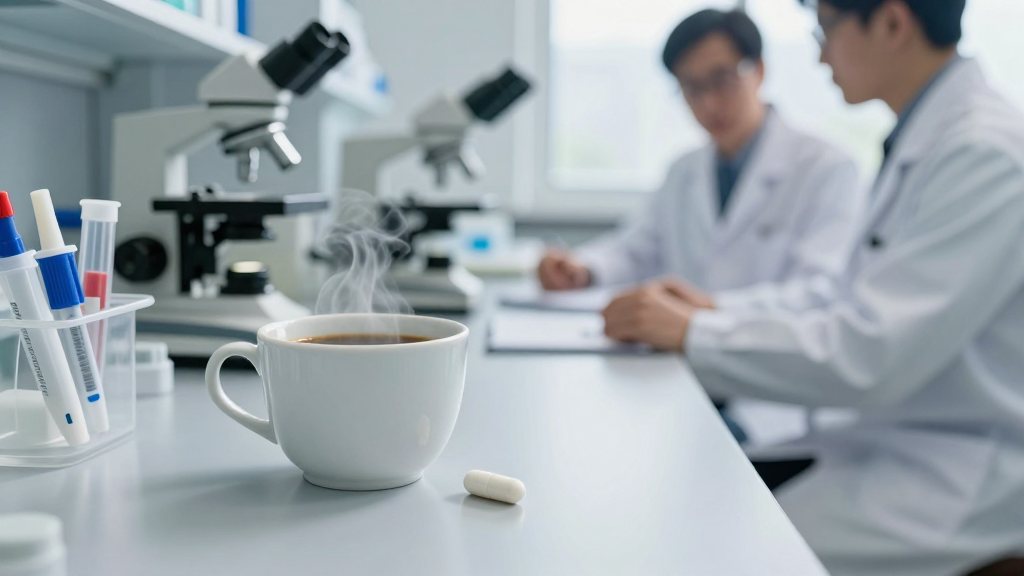
COPENHAGEN — Coffee, the beverage the United States measures its workday by and its friendships around, has become the first legal drug in history to be formally looked at from the inside. Researchers at the University of Copenhagen spent nine days watching what regular coffee drinking does to the human gut, and the gut, they announced this week, looks different.
1. The Question
Everyone knows coffee does something. The knowing is cultural, contractual, and has been settled by habit since before labs existed. What science did not have, until this study in the journal Gut Microbiology, was the something: measured, numbered, and attached to actual plumbing.
2. The Subjects
Sixty-one healthy Danish adults — every one of them, by now, a minor celebrity in the coffee industry, which is the only industry that would name a breakfast sandwich after them. Volunteers were sorted into habitual coffee drinkers, defined as one to five cups a day on most study days, and everyone else, a group science calls “the less often” and Denmark calls, at this point, nothing.
3. The Capsule
The participants swallowed a small electronic capsule, an honest little device, and rode it with their attention elsewhere as it traveled the entire digestive tract measuring the things nobody had measured: transit time, temperature, pH, and the contractions of the intestine itself. The capsule performed its work in privacy and dignity, the way a good civil servant does, and retired at the end of its assignment into a collection cup.
4. The Findings
Three, and each arrived with the modesty of a result that knows it is going to be misquoted immediately. Habitual coffee drinkers hosted a wider variety of gut bacteria — more diversity, the good kind, the kind organizations write mission statements about. Their small intestines measured more acidic. Their colons contracted more frequently and more strongly. The colon, in other words, is more engaged. It is participating.
5. The Response
American readers are advised to process this in order. First: for 250 years, Americans have run an unregulated, nationwide, self-administered trial of coffee involving roughly 160 million subjects, most of them started before age sixteen, none of them paid, all of them volunteers. Second: the trial’s entire published record until this week was a feeling, a ritual, and a mug that says DON’T TALK TO ME BEFORE BREW. Third: the trial is now, retroactively, peer-reviewed. The results say the gut is changed and the change is mostly the kind scientists describe with the phrase “suggesting benefit,” which is how science says “we are being extremely careful in public.”
The researchers stress the sample was small, nine days is brief, and causation remains unproven — the three sentences that appear in every serious study, placed there because seriousness is a filing requirement. Denmark’s coffee culture, meanwhile, survived the announcement, and Denmark’s coffee culture consists almost entirely of filter coffee drunk at desks, which the study suggests is now a mild medical intervention performed at desks.
The capsule itself was the study’s most durable achievement. It measured everything, asked nothing, and completed a full tour of the American’s least-visited real estate. It has since been manufactured in larger quantities, because the capsule, unlike the gut, scales.
The study cost roughly what a mid-sized espresso machine does. The knowledge it produced — that coffee moves you, in both senses, and that your bacteria enjoy it — had previously been available from anyone, at any hour, for free, usually at 7 a.m., usually with words that are not print-ready.
Reader Comments (9)
These comments were written by our staff. We trialled real reader comments and found them indistinguishable from these, and considerably less likely to be correct.
Posting is open to readers who finished the article. Nobody has ever qualified.
Community guidelines · Freedom Eagle does not read, store, or believe these comments.