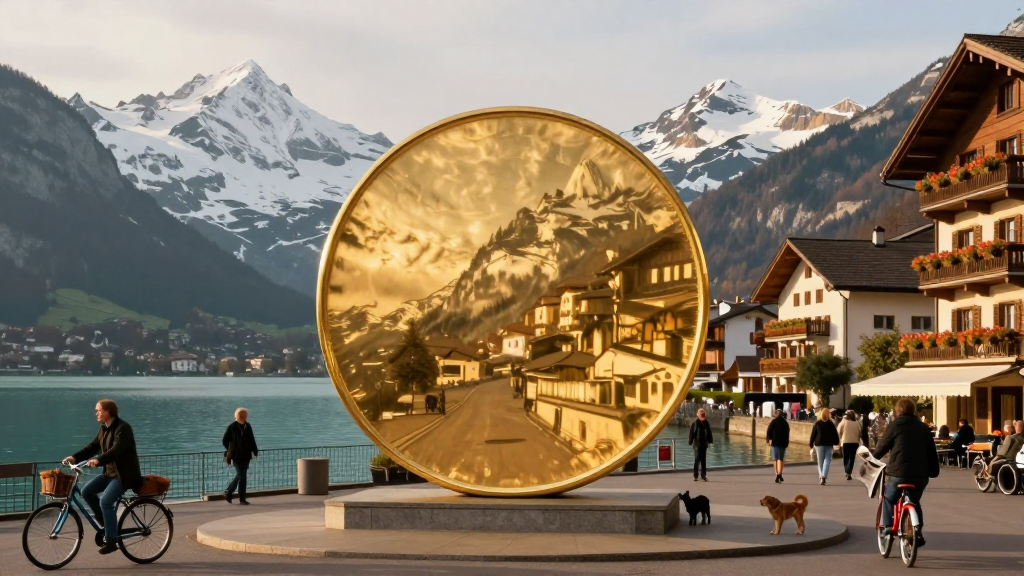
LUGANO, Switzerland — The lakefront is the front page of a city of roughly 65,000 people at the foot of the Alps, and this autumn the town has put a new headline on it: Lugano, the Swiss city that has begun running part of its local economy on a private coin printed in the room next door. The city is deepening its joint venture with Tether, issuer of USDT, the world’s largest stablecoin, under the “Plan B” program that lets residents settle certain municipal charges in digital tokens and promises to expand the list each season. A town famous for two things — a lake and banking — has decided the honest move is to combine them.
The mechanics are more municipal than the word “wonderland” suggests. No one buys fish with blockchain here. A defined list of administrative fees can be paid in tokens; the city’s partner supplies the rails, the promotion, and a marketing vocabulary borrowed wholesale from a convention center. Critics — and the city’s own editorial pages have produced them at industrial volume — warn that a government that lends its credibility to a coin inherits the coin’s reputation when the coin has a news cycle. The city’s answer has been the answer of every town that has ever cut a ribbon: the risks are theoretical, the conference bookings are not.
What makes Lugano interesting to the financial world is not the tokens. It is the zoning. Swiss regulators drew a fence around the experiment — charges, not salaries; receipts, not savings; audited, not aspirational — which turns the city into something rare in crypto: a boring pilot. The town itself understood the assignment early; this is a place that has hosted more bailouts of more foreign governments than most capitals, and it approaches the stablecoin exactly the way it approaches a tourist season — staffed, insured, and expected to end on schedule.
The residents approach it in three bands, which is the correct number. The takers hold up their phones at the tax counter for the sport of it. The observers, led by the retired choir conductor class, have concluded that the future is a QR code on an easel and intend to be photographed next to it with great disapproval. And the third band, the cyclists, report that nothing has changed, which both the promoters and the critics agree is either the entire point or the entire problem.
The gelatiere on the west quay, who accepts tokens on slow afternoons out of what he describes as civic curiosity, offered the week’s most quoted sentence while handing a teenager a stracciatella: the gelato costs the same, takes the same time to make, and arrives in the same cone, which he considers either proof the system works or proof the system does not exist, depending on the day. The city plans to add more fees to the token list before winter. The critics plan to print more op-eds before the next ribbon. The lake, which has been the town’s actual reserve asset since before the Confederation, remains pegged to itself.
At press time, the city’s last branch of a traditional Swiss bank had posted its strongest quarter in a decade — the surest sign a wonderland is functioning that finance has ever produced, which is that the old exits get crowded exactly when the new entrances do.
Reader Comments (7)
These comments were written by our staff. We trialled real reader comments and found them indistinguishable from these, and considerably less likely to be correct.
Posting is open to readers who finished the article. Nobody has ever qualified.
Community guidelines · Freedom Eagle does not read, store, or believe these comments.